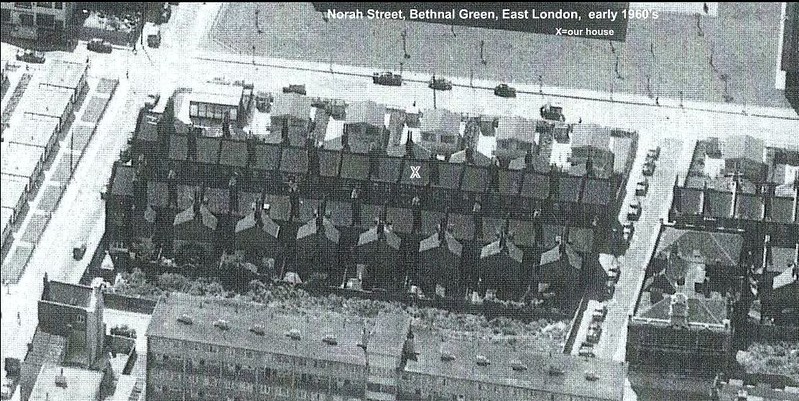
45 Norah Street, Bethnal Green, London, E.2 was my address for the first 20 years of my life. The street was built, according to a stone plate on one of the houses, in 1884. Actually it was two squares with a through road (Ivimy Street) . In 1884 there was no electricity and there were gas holders in all the rooms which were lit as illumination. Heating was by open coal fire and in the garden there was a large shed for keeping the coal reserves. In the kitchen there was an open coal fire and next to it a built-in oven and cooking range which took its heat from the fire. Hot water didn't exist, neither a bathroom or an inside toilet. All water had to be boiled and washing was done once a week by boiling water together with the washing in a large container.
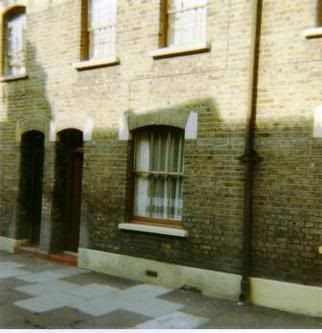
My grandfather and granmother got married in 1907 and this was when they moved into the street. They both grew up in the East End of London and were happy to find somewhere where they could live and bring up their family. They moved into the 3 lower rooms of the house in the picture above, having a kitchen/living room and 2 bedrooms. The toilet was in the garden and shared with the family living upstairs in the house who had the same amount of rooms as my grandparents. The family grew bigger and there were 3 daughters (my mum being the youngest daughter) and a son, the youngest child. There were 6 people living in 3 rooms. Upstairs there was a family that had 6 children so there were 14 people living in the house, not to mention that all shared the same toilet in the garden. Every house had its garden, small but it was there and every garden had chickens or other livestock. My grandfather had chickens and also according to my mum a duck. The drainage was a rain pipe down the wall of the house where all water went from the sink and there was a large sink in the garden. This was blocked from time to time to let the duck have a swim. There were also 2 dogs and a cat in the family.
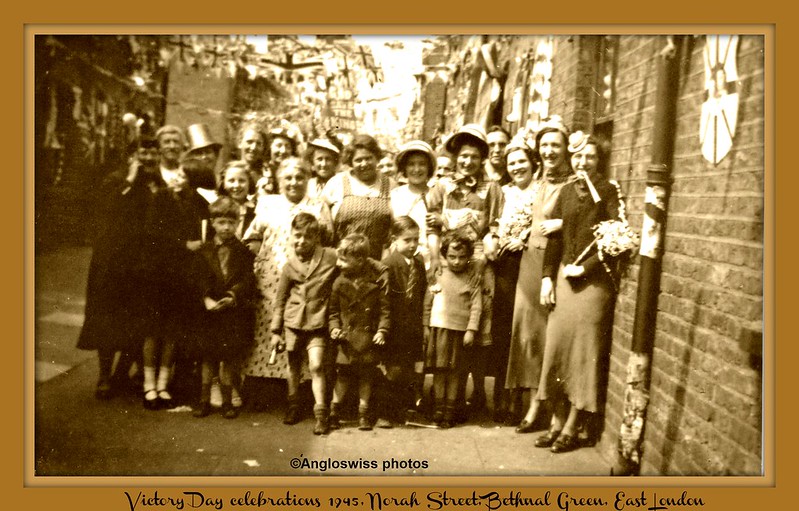
Time went on and two world wars passed through the street, but leaving the street standing completely. At the end of World War II there was a street party where everyone in the street celebrated together.
During the war people slept in their gardens at night. "Nissen huts" had been erected for the inhabitants as it would have been too dangerous to sleep in the houses during the bombing raids. This part of London was very near the docks and a dangerous area.I grew up in this street and remember it well. As a child I first of all slept in the same room as my parents, but when I got older had my own room. We were then living in 3 rooms, a kitchen/living room/dining room and two bedrooms. My grandfather lived in the 3 rooms downstairs. Rent was paid once a week and a rent collector came for the money. Although I remember the open fire in the kitchen and the cooking facilities, my mum had a gas cooker which was to be found on the landing (3 steps leading up to a corner before the bedroom). How she complained about the 3 steps up and down all the time. My bedroom still had the gas fittings although we did have electricity. My mum was always proud to tell me that her mother was one of the first people that signed to have electric cables put down for the street.The drainage system was very basic. There was a large pipe leading down the walls of the house outside. There was a smaller pipe from the sink leading into the larger pipe. The water then went into the drain in the garden. If the drain got blocked for some reason or another, you had a problem. In Winter under cold temperatures the water would freeze in the system and usually you found that the pipes leading to and from the houses were covered in "lagging" (anything that gave warmth like sackcloth was wrapped around the pipes and fixed by string to stop freezing).Heating was orginally from a fireplace. I remember how to make the fire. First of all newspaper, afterwards a layer of wood and finally the coal. If the coal wasn't so good it would crack and spit and sparks would fly. The better quality coal burnt nicely with no problem. I think my mum and dad knew all the names and qualities of the coal you could buy. The coal was brought by the coalmen in sacks which they somehow carried on their heads. We had an enormous coal bunker in the garden where it was tipped into. Later coalfires were forbidden and all the houses were fitted with gas fires.For the first 10 years of my life we didn't have a refrigerator, but a so-called "safe" out in the garden. It was a small cuboard for keeping perishable food items. In Winter ideal, but in Summer we had to find other solutions. Usually filling up a bowl with cold water and putting the milk bottles and butter in it. The toilet was still outside (how I hated the insects especially spiders that usually lived there) and as a kid my weekly bath was in the kitchen in a metal tub. As I got older it was once a week to York Hall public baths.
School was in walking distance from the house - as was everything in those days - and I was usually accompanied on the way by other kids from our street. It was a sort of paradise for us kids growing up. We had a square with no through traffic and as can be seen in the picture above there were paving stones - very handy for drawing on with chalk and playing hopscotch. We could skip and had a lamppost in the middle of the street. If you managed to hang your skipping rope on it you could swing around (until our mums told us not to). Otherwise the lamp posts were good training for climbing. As we got older we had roller skates and the road in between the two squares had a slope which was ideal for rolling down. The street was full of playing kids, mothers standing at the doorsteps and grandparents sitting outside on their chairs watching the world go by.As I mentioned our street was luckily not hit during the war, but it seemed that most streets around us were. For us kids this was adventure playground live. Playing in the "debris" of the bombed out houses - dangerous but enjoyable. I remember some of the "gardens" left from the houses. The flowers just grew wild and I often brought my mum and bunch of flowers home from the playground.We had some interesting neighbours. My mum knew them all as most of the women were at school with her. That was probably why she always called them by their single names. Even their children who I went to school with were known with their mother's single name. She just didn't know the paternal names.
Next door there were 2 sisters of my mum's age living on the bottom floor with their mother.The third sister had married and lived upstairs with her husband. Opposite there was an elderly couple without children, but my mum knew their son well - he never came home from the 2nd world War. 3 doors further down there lived a married couple. The man of the house kept racing pigeons in the garden. The garden was full of pigeon lofts. He would let them out for a fly and then stand outside called "comeon, comeon" and shaking a bag of their food and in they would come one after the other. They also had a dog and I remember his wife going for a walk early in the morning dressed in her nightdress with a long dressing gown over it. Opposite there lived a small wide lady whose main hobby was polishing her door nob. We all had door nobs as well as a door knocker. Her door nob was brass and shone like a golden sun. Even the wood around the nob had a different colour to the black wood of the door due to the cleaning she did all the time. My Aunt lived opposite with her husband on the top floor of one of the houses, She shared the house with two sisters that lived downstairs and who she didn't get on with so well. I remember when I was on a visit that I had to walk through the sister's kitchen to get out into the yard where the toilet was. They had hung a thick blanket up to stop people looking into their kitchen.
As the years went by electicity became more and more important. Unfortunately our electric installations were fairly basic and it was a miracle that nothing ever happened. My dad did most of the electrical installations and we usually had one main plug in a room where he made a lead to another plug in another room which also connected to another plug in a third room. I don't know today how it all worked. I remember our first television, very small but we had one. We were one of the first families in the street to have one, so when the Cup final at Wembley was being played our house was usually full of the men of the street invited to watch the match. Everyone brought their own beer and my mum and I usually went out shopping or perhaps a visit to the cemetry.
With time my grandfather died at the age of 89 (showing that the conditions couldn't have been that bad after all) and we took over the complete house. My bedroom was then downstairs and the window in the top picture became our living room (but we rarely used it). I think we just lived in the kitchen. We even had a piano. In my mothers younger days many parties were held in the house and each one of my aunts could "play" - who cared as long as you sung loud enough. They could all pick out the tunes with their right hand, their lefthand was a bit dodgy.
Then came the day when the late Dusty Springfield visited Norah Street to make a television commercial for Wonderbread (I think that was the name of the bread). The advertising company found that our street was a perfect setting for the scene. The television crew arrived, together with Dusty Springfield and her group, as well as a coach full of extras that was parked in Squirries Street backing onto Norah Street. The filming soon began and we all had the chance to see and hear Dusty singing her "bread" song (playback) and watching the filming. The extras all hid in the many doorways of our square and when the music started they all came out into the street, some on roller skates, some running and some walking. The filming must have taken at least a week. We were astonished most of all watching the "extras". They seemed to spend more time sitting in their coach than actually taking part in the filming. All the inhabitants of the street were naturally glued to their televisions when the commercial was shown.
If there is anyone of the younger generation who doesn't remember the great Dusty Springfield - here is a reminder - one of her finest songs.
Things stayed this way and I eventually left home at the age of 20. I remember my mum's biggest wish was that she would eventually be rehoused into a council house. A few years later the wish was fulfilled and moved out with the rest of the street further East of London. Some people remained in East London, but my mother didn't want to.
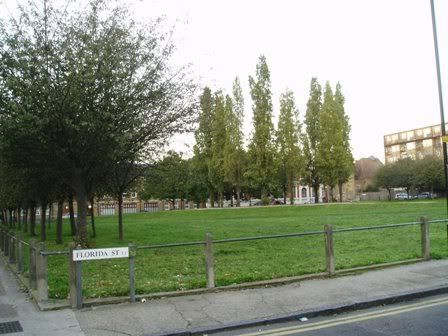
The end of Norah Street came around 1974 when it was pulled down. Now in its place there is a small park - difficult to imagine that once more than a hundred houses, 3-up - 3-down, were on such a small space. Our Cat Whisky perched on our window sill on the top floor
He loved watching the sparrows on the opposite roof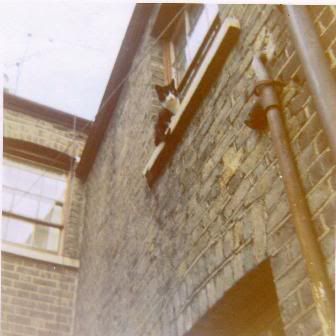
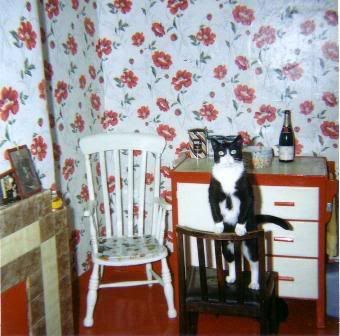
Cat Whisky in our kitchen/living room/dining room
The rooms were very small - note the wallpaper to brighten things up a bit
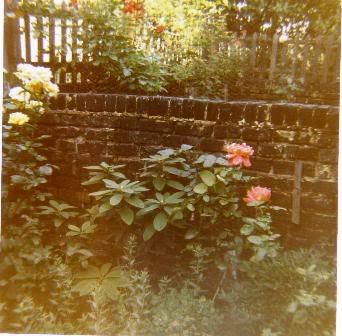
Even Roses grew in our small back yard
Norah Street November 2006